


For a long time, studying abroad meant only one thing. You packed a bag, got on a plane, and lived in another country for three or four years. That option still exists, but it is not the only one anymore. Although, you can begin your degree online from home and complete it on a real college abroad with hybrid study abroad programs. You get the international degree without leaving everything behind on day one.
This article discusses what hybrid study abroad actually means, the countries that offer it, how much it costs in comparison to a traditional study abroad program, and how to apply. We intentionally avoided using complex terminology because this choice is already troubling enough.
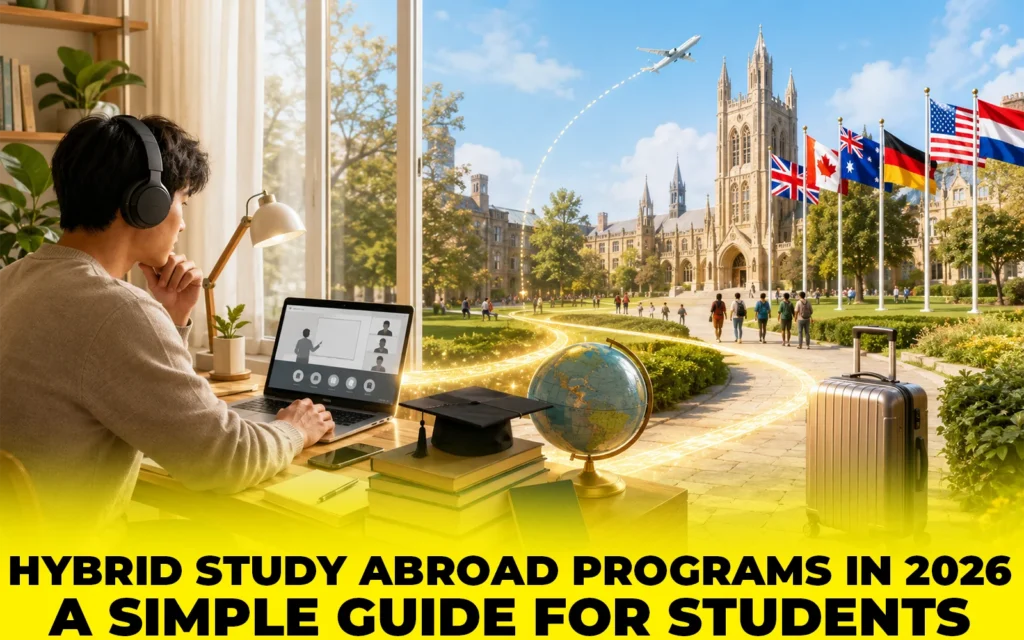
What is Hybrid Study Abroad Programs
A hybrid study abroad program mixes two things: online classes and in person classes. You study part of your degree from your own country, usually through video lectures and online coursework. Then you travel abroad to finish the rest of the degree on campus.
This is not the same as a fully online degree, where you never travel at all. It is also not the same as a normal study abroad program, where you move overseas for the whole time. Hybrid sits in between the two.
Why is this growing in popularity in 2026? Families are becoming more cautious about committing to a full academic year overseas due to rising living and tuition costs in nations like the UK, Canada, and Australia. Because students only have to pay for lodging and transportation while they are on school, a hybrid study plan can help lower overall costs. While waiting for their student visa to be accepted, many students can begin their studies remotely because to universities’ significant advances in the quality of online learning. This flexibility facilitates a far smoother adjustment to studying abroad and saves significant time.
That said, hybrid students still need to check the rules carefully. A program that looks hybrid on a website does not always come with the same visa rights as a full time, on campus degree. We explain this country by country below.
Types of Hybrid Study Abroad Programs
Not every hybrid program works the same way. Here are the four main types.
Online Start then Campus Finish Model
This is the most common setup. You study online for a set period, often one semester or a full first year. After that, you travel abroad and finish the rest of your degree in person. Business schools use this model a lot, since it lets working students keep their jobs a little longer before moving.
Split Campus Model (Home Country and Abroad)
Under this strategy, you initially attend a local partner college in your home country. Then you transfer to the partner university internationally to complete your degree. Before you make the big move, you receive help from people who are familiar with your past, and fees are typically lower during the local part.
Short Term Residency Programs
With this study model, you complete most of your classes online from home and travel abroad only for short, focused study periods, usually lasting between two and four weeks. During these visits, you take part in activities that benefit from face-to-face learning, such as laboratory sessions, practical training, workshops, and specialised seminars. Moreover, it is a practical option for students who cannot relocate for an entire academic year but still want to experience studying on an international campus and build global exposure.
Fully Flexible Online and Offline Programs
Some universities let you choose, term by term, whether you want to study online or in person. There is no fixed rule about when you must travel. This gives you the most control, but it also means you need good self-discipline, since nobody is telling you when to move.
Top Countries Offering Hybrid Study Abroad Programs
United Kingdom (Leading Hybrid Universities)
The UK has offered distance learning for a long time. The University of Manchester runs online master’s courses and diplomas that students can join from anywhere in the world, and the University of Liverpool has offered online postgraduate degrees since the year 2000. Both universities now blend in person elements into several courses.
Not every hybrid program qualifies for a UK Student visa. Programs that do qualify usually follow either an intensive block model, where you study online most of the year but attend campus for two to four week blocks, or a regular attendance model, where you attend campus weekly. Some advisers say around 40 percent of a taught course should happen in person for a visa to be approved, though the Home Office has not published one exact number, so always confirm this with the university directly.
This also affects the Graduate visa, the UK’s route for working after graduation. Students are normally expected to finish their studies inside the UK to stay eligible, though exceptions have applied in the past for students who studied part of their course by distance learning and completed their final term in the UK. As of 2026, the Graduate visa lasts two years for most students who apply on or before 31 December 2026, drops to eighteen months from 1 January 2027, and lasts three years for PhD graduates.
Australia (Online Start Campus Finish)
The primary focus of Australia’s student visa is full-time, in-person study. Instead of a single hybrid track, the majority of these courses operate through collaborations with foreign universities. Additionally, applicants must pass the Genuine Student criteria, which took the place of the previous Genuine Temporary Entry exam in 2023. An officer will carefully consider the sustainability of your study plan. A hybrid route into Australia should be carefully examined by a qualified migration agent.
Germany (Blended Engineering and Tech Programs)
Particularly in engineering, Germany has traditionally used a combination of classroom instruction and practical training. Some technical colleges have extended this into blended learning environments for international students. Additionally, public colleges maintain a significant economic advantage by charging minimal or no tuition at many levels. Lastly, there isn’t a single national regulation for hybrid programs in Germany, so always check with each university about the structure and specifics of the visa.
Canada (Hybrid College Programs)
Canada has some of the clearest rules on hybrid study, and also some of the strictest. Fully online programs do not qualify for a study permit or a Post Graduation Work Permit (PGWP) at all. Some blended programs qualify for a study permit but not a PGWP, while others qualify for both, depending on the school.
For programs that began on or after September 2024, at least 50 percent of the course must be completed in a classroom inside Canada. Time spent studying outside Canada is subtracted from your future PGWP length. A program with too much online study at the start can shrink a three year work permit down to something much shorter, or remove eligibility completely. Most applicants also now need to meet a language test requirement. The good news is that Canada is upfront about these rules, so planning ahead with your school can avoid surprises.
USA (Flexible Online and On Campus Options)
Many universities in the United States, particularly at the postgraduate level, have long offered flexible learning options designed for working professionals. However, students studying on an F-1 visa are generally required to maintain full-time, in-person enrolment. Moreover, with only limited online study permitted typically no more than one online course or up to three credits per semester while in the US. As a result, most hybrid programs are structured so that students complete the online portion before travelling. While the in-person component begins after they arrive under their F-1 visa. Since program structures and immigration requirements can vary. Furthermore, it is always advisable to confirm the latest rules with your university’s international student office before making plans.
Netherlands (English Hybrid Programs)
Dutch universities are known for teaching in English, and more are experimenting with blended formats, especially in business, data, and technology courses. The Netherlands does not have one widely known standard hybrid visa category, so if a program page says “hybrid,” check with the Dutch immigration service (IND) and the university before assuming it comes with the same rights as a full time degree.
Benefits of Hybrid Study Abroad Programs
Lower Cost Than Full Time Campus Study
This is the main reason most students look into hybrid study. Since you only pay for housing, travel, and daily living during the shorter time you are actually abroad, the total cost usually comes out lower than a fully in person year. This matters most in expensive cities like London, Sydney, and Toronto.
Flexible for Working Students and Families
Taking a year off from employment or family obligations is just not feasible for many students. While pursuing an internationally recognized degree, hybrid education provides the option to continue working or taking care of responsibilities at home. One of the primary reasons hybrid MBA programs are now far more common than hybrid undergraduate degrees is this balance between study and daily living.
Global Exposure Without Full Relocation
You still get international classmates, guest lectures, and group projects with students from other countries, even during the online part. It is not the same as living abroad full time, but it gives you a real taste of the culture before you commit to moving.
Access to World Class Universities From Home
A student in a small town, or a country with limited local options, can start classes at a well-known international university without first sorting out a visa, flights, or housing. This lowers the barrier a lot, especially for students whose families are nervous about a sudden big move.
Easier Visa Requirements in Some Cases
This is not always true, so treat it with caution. When the online part happens before you travel, you can avoid the stress of applying for a visa before studies begin. But as the Canada and UK sections show, hybrid study can also make visa and work rules more complicated. Do not assume “easier” applies to your case without checking first.
Hybrid Study Abroad Programs vs Traditional Study Abroad
Cost Comparison
Hybrid programs are usually cheaper overall, mainly because you spend less time paying for housing and travel abroad. Tuition is sometimes the same for both versions of a degree, so the real savings come from daily living costs, not the school fee.
Visa Requirements Comparison
Traditional study abroad is usually the simpler visa path, since most immigration systems were built around full time, in person study. Hybrid students often need to prove more, including a clear breakdown of which part of the course happens where.
Degree Recognition Comparison
Most degree certificates do not say how a course was delivered, so hybrid degrees usually look the same as on campus ones once you graduate. Some fields, like medicine or lab based sciences, still lean toward valuing in person training more.
Career Outcome Comparison
For most business and academic fields, career results between hybrid and traditional graduates look similar, as long as the degree comes from an accredited school. The bigger factor is usually whether you kept strong post study work rights, since a shortened PGWP in Canada can affect your career more than how your classes were delivered.
Best Hybrid Study Abroad Programs by Course
Business and MBA (UK and Australia)
Business schools were early adopters of the intensive block model, where students study online and travel for short, focused campus visits. This suits working professionals well, since employers are usually more willing to give a few weeks off than a full year.
Data Science and AI (Germany and Netherlands)
Tech fields fit naturally into online study, since much of the work happens on a laptop no matter where you are. Germany and the Netherlands have been expanding hybrid options here, but always check the visa details with each school first.
Engineering (Germany and Canada)
Engineering hybrid programs usually put theory online first, then require in person lab work that cannot be done remotely. In Canada, this in person time directly affects your PGWP length, so ask exactly how much of the course counts as classroom time.
Health and Nursing (Australia and UK)
Clinical placements make fully online study impossible in health fields. Programs here combine online theory with required in person clinical hours, which can actually help when applying for a visa, since the in person time is easy to document.
Education and Teaching (USA and Ireland)
Teacher training programs often mix online lessons with required in person teaching placements. Ireland has drawn interest for its lower cost of living compared to the UK and its openness to post study work.
How to Apply for Hybrid Study Abroad Programs
Step 1 (Research Eligible Universities)
Look for universities that clearly explain their hybrid structure, including how much of the course is online versus in person, and whether it is recognized for visa purposes. If a university cannot answer this clearly, take that as a warning sign.
Step 2 (Check Visa Requirements for Hybrid Students)
Give this step real time. Hybrid study can affect your visa, your post study work rights, and even whether you get a study permit at all. Ask the university’s international office to confirm, in writing, how their program is classified under current immigration rules.
Step 3 (Apply Online and Submit Documents)
Apply through the university’s normal process, which usually includes transcripts, English test scores, a personal statement, and references. Hybrid applicants sometimes need an extra study plan explaining the move from online to campus, especially for countries like Australia.
Step 4 (Complete Online Phase From Home)
Take the online phase seriously. Your attendance and performance here often affect whether you can move on to the in person phase, and in some countries this record can be reviewed later during a visa decision.
Step 5 (Travel for Campus Residency Phase)
Before booking flights, confirm your visa or study permit is approved and check the exact date your in person phase starts. Arriving too early or too late can cause problems, especially where strict in person time rules are tied to work permits.
FAQs
Are hybrid study abroad degrees recognised by employers?
Usually, yes. Most degree certificates do not say whether a course was online, in person, or hybrid. Fields with strong hands on needs, like medicine, may still lean toward valuing in person training more.
Do hybrid students get a student visa?
It depends completely on the country and the program. In the UK, only certain hybrid formats qualify. In Canada, some blended programs qualify for a study permit but not a PGWP, while others qualify for both. In Australia and the US, hybrid pathways usually work best when the online part happens before you arrive. There is no single answer that fits every country.
Can I get PR through a hybrid study abroad program?
In countries where permanent residence is linked to post study work, like Canada, hybrid study can make things harder if it shortens your work permit. Programs that lean heavily on distance learning can see their PGWP length reduced, or lose eligibility completely. If PR is your goal, map out the in person requirement before choosing a program.
Which universities offer hybrid study abroad programs?
A growing number do, especially for postgraduate degrees. In the UK, the University of Manchester and University of Liverpool have offered online and blended programs for years. Universities across Germany, the Netherlands, Canada, and the US also offer hybrid options, though structure varies a lot by school.
Is hybrid study abroad cheaper than full campus study?
In most cases, yes, mainly because of lower living and travel costs rather than lower tuition. Exact savings depend on the country and how long your in person phase lasts.
Ready to Explore Hybrid Study Abroad Options?
Hybrid study abroad is not a shortcut, and it is not right for every student or every course. But for the right person, it opens a door that a full four year move overseas simply cannot. Before you fall in love with a university website, map out the visa and post study work rules for your target country first. Talk to a study abroad counsellor, contact the international office at any university you are considering, and get the in person requirement confirmed in writing before you commit.
Why Choose Study Abroad Updates?
We are your one-stop website for everything related to studying abroad. Our website is made to give you all the information you need to have a fun and easy path toward studying abroad. We can assist you whether you’re seeking for the best places to study, the newest scholarships, or university rankings. Get in touch with us for individualized advice, or view our videos to learn more about the university of your dreams. Our Study Abroad Genie is available around the clock to help you at every stage. Take the first step toward reaching your objectives by starting your study abroad journey with us right now. Get the most recent opportunities, professional advice, book a free session and chat with us at every time in just one click.